The Criminal Justice System, in its purest state, is the delivery of justice to the convicted. The ideal vision of criminal justice in society is one which is beneficial towards the convicted, where human engagement is generally improved through rehabilitation, prevention of any further crimes, and moral support for the well-being and safety of the victim. But as we border mass incarceration with 2.3 million people behind bars (minus those on parole or probation), it seems as if the Criminal Justice System is simply a way to instill false justice. This “justice” is provided at the expense of the convict, who is quickly put behind bars, while the witness and police receive satisfaction for the jailing. Ultimately, many are willing to overlook the innocence of criminals in search of this fake justice, which comforts the witness, and bolsters the public image of the police department. As time goes by, society will continue to change the theories behind what is justice for a criminal and the victim. So, if we have come as far as to say that we have the highest incarceration rate globally, where did this all start?
The general idea of prison reform and criminal justice has come a long way since its beginning. One great example of the growth of prison reform is the Pennsylvania Prison System. Before the 1700s, the goal of criminal justice was for the convicted to get a retributive punishment for their crime. Penalties include the death sentence for the worst crimes, while other crimes ended in hanging, ear cropping, beheading, burning, public humiliation, and branding. In 1680, the first acts to end the current prison system were attempted but later failed due to the death of their creator, William Penn. It wasn’t until the birth of the Pennsylvania System that the Quakers finally got what they asked for.
In 1787, Benjamin Franklin and a group of Philadelphian Quakers joined forces to create what was the Philadelphia Society (later became the Pennsylvania Prison Society). The Quakers offered a problem-solving approach to the brutal criminal justice system of the 17th-18th centuries. The Pennsylvania Society was an attempt to focus on incarceration and rehabilitation rather than retribution and deterrence. The Pennsylvania System was a major jump in prison reform, so its ability to raise doubts from the public was unknown.
The Philadelphia Prison Society converted the Walnut Street Prison into the nation’s first penitentiary for rehabilitation, in which one was held in complete isolation or “solitary confinement.” This system was called the “Pennsylvania System.” The ideal purposes of this system was to give inmates time to reflect on their deeds and indulge in remorse, and (similar to today’s) to prevent criminals from committing further crimes after being released. They did so by occupying inmates with work. The prison was built to have one person rooms with little window space to view the outside world, and inmates would see nobody but their guard. They were given tools to make shoes, clothes, and nails, but nothing else. At first glance, outsiders showed enthusiasm for the new system. For all they knew, criminals were off of the streets. But step inside of the prison walls, and enthusiasm was the last thing that you would see.
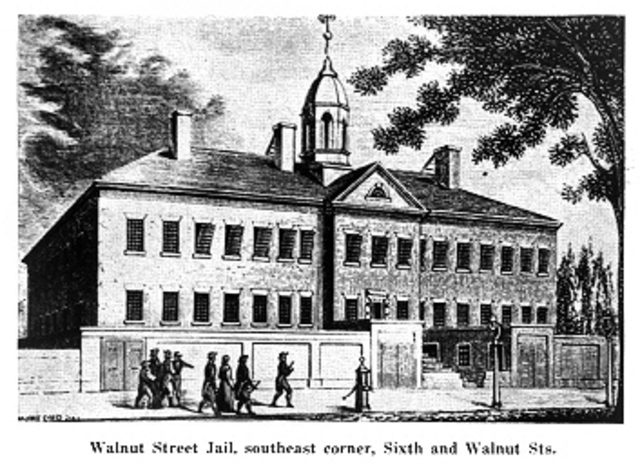
Despite the initial successes of the prison, the high expenses lead to major overcrowding. Forty inmates were stashed into fifteen by fifteen-foot rooms at a time, and the once “ideal” prison system was beginning to fall apart. To solve the crowding issues, the Walnut Street Prison was then split into two larger prisons, named Eastern State and Western State Penitentiary. Both penitentiaries followed the same solitary confinement system as Walnut Street Prison until the Western State Penitentiary failed to continue it. Eastern State somewhat succeeded at maintaining the solitary system until it converted to the congregate system in 1913. Questions about the effects solitary confinement rose as evidence showed inmates going mentally insane due to the lengthy amounts of time spent isolated. So, did the Pennsylvania System succeed at what it was set out to do?
Even though the Pennsylvania System didn’t succeed at surviving, it succeeded at playing a major role in America’s prison reform systems. The problem solving and ambitious dreaming done by the Philadelphia Society members shifted the main focus of criminal justice from retribution to rehabilitation. The Pennsylvania System set the stage for prison reform around the nation. Whether or not it succeeded, it is easy to say that the Pennsylvania System kickstarted the act of prison reform and gave America a staggering new perspective of the Criminal Justice System.

Resources:
https://www.cor.pa.gov/PCI/Pages/History.aspx
https://study.com/academy/lesson/the-pennsylvania-prison-system-history-reform.html
https://www.smithsonianmag.com/history/eastern-state-penitentiary-a-prison-with-a-past-14274660/
 Problem Solving & Dreaming Big in History: Making Philadelphia